Wymiarowanie źródła ciepła w instalacjach ze stacjami mieszkaniowymi: Różnice pomiędzy wersjami
Przejdź do nawigacji
Przejdź do wyszukiwania
Nie podano opisu zmian |
Nie podano opisu zmian |
||
| (Nie pokazano 2 wersji utworzonych przez 2 użytkowników) | |||
| Linia 28: | Linia 28: | ||
<!-- Do not write text below this tag --> | <!-- Do not write text below this tag --> | ||
<br class="iwlinks"/>[[en:Heat source dimensioning for installations with flat stations|Heat source dimensioning for installations with flat stations]][[zh-cn:采用户用换热机组系统的热源能力的确定|采用户用换热机组系统的热源能力的确定]] | <br class="iwlinks"/>[[en:Heat source dimensioning for installations with flat stations|Heat source dimensioning for installations with flat stations]][[bs:Heat source dimensioning for installations with flat stations|Heat source dimensioning for installations with flat stations]][[zh-cn:采用户用换热机组系统的热源能力的确定|采用户用换热机组系统的热源能力的确定]][[cs:Heat source dimensioning for installations with flat stations|Heat source dimensioning for installations with flat stations]][[da:Heat source dimensioning for installations with flat stations|Heat source dimensioning for installations with flat stations]][[et:Heat source dimensioning for installations with flat stations|Heat source dimensioning for installations with flat stations]][[es:Heat source dimensioning for installations with flat stations|Heat source dimensioning for installations with flat stations]][[fi:Heat source dimensioning for installations with flat stations|Heat source dimensioning for installations with flat stations]][[fr:Heat source dimensioning for installations with flat stations|Heat source dimensioning for installations with flat stations]][[hr:Heat source dimensioning for installations with flat stations|Heat source dimensioning for installations with flat stations]][[hu:Heat source dimensioning for installations with flat stations|Heat source dimensioning for installations with flat stations]][[fa:Heat source dimensioning for installations with flat stations|Heat source dimensioning for installations with flat stations]][[lv:Heat source dimensioning for installations with flat stations|Heat source dimensioning for installations with flat stations]][[nl:Heat source dimensioning for installations with flat stations|Heat source dimensioning for installations with flat stations]][[nb:Heat source dimensioning for installations with flat stations|Heat source dimensioning for installations with flat stations]][[sv:Heat source dimensioning for installations with flat stations|Heat source dimensioning for installations with flat stations]][[sl:Heat source dimensioning for installations with flat stations|Heat source dimensioning for installations with flat stations]][[sk:Heat source dimensioning for installations with flat stations|Heat source dimensioning for installations with flat stations]][[tr:Heat source dimensioning for installations with flat stations|Heat source dimensioning for installations with flat stations]][[sr-el:Heat source dimensioning for installations with flat stations|Heat source dimensioning for installations with flat stations]] | ||
Aktualna wersja na dzień 23:50, 19 lis 2021
| Produkt | InstalSystem 5 |
| Typ artykułu | TYPOWY PROBLEM |
| Ostatnia aktualizacja | GOLD Rev. 16.0 |
Opis problemu
Sugeruje się, aby dobór mocy źródła ciepła skonsultować każdorazowo z producentem stacji mieszkaniowych. W razie braku szczegółowych wytycznych zaleca się zastosowanie jednego z poniższych rozwiązań.
Sposób rozwiązania
- Jeśli w ramach źródła ciepła brak zbiornika buforowego - wtedy do wymiarowania źródła ciepła należy przyjąć wartość Moc całkowita.

1. Moc całkowita. - Jeśli w ramach źródła ciepła uwzględniany jest zbiornik buforowy - podawana przez program wartość Moc całkowita jest mocą szczytową jaką ma zapewnić w instalacji zbiornik buforowy. Natomiast samo źródło ciepła sugeruje się wymiarować na sumę projektowego obciążenia cieplnego budynku (lub w razie braku obliczeń normowych, sumę obciążeń cieplnych pomieszczeń) z uwzględnieniem niewykorzystanych strat ciepła działek i niewykorzystanych strat ciepła ogrzewań płaszczyznowych (na zewnątrz budynku).
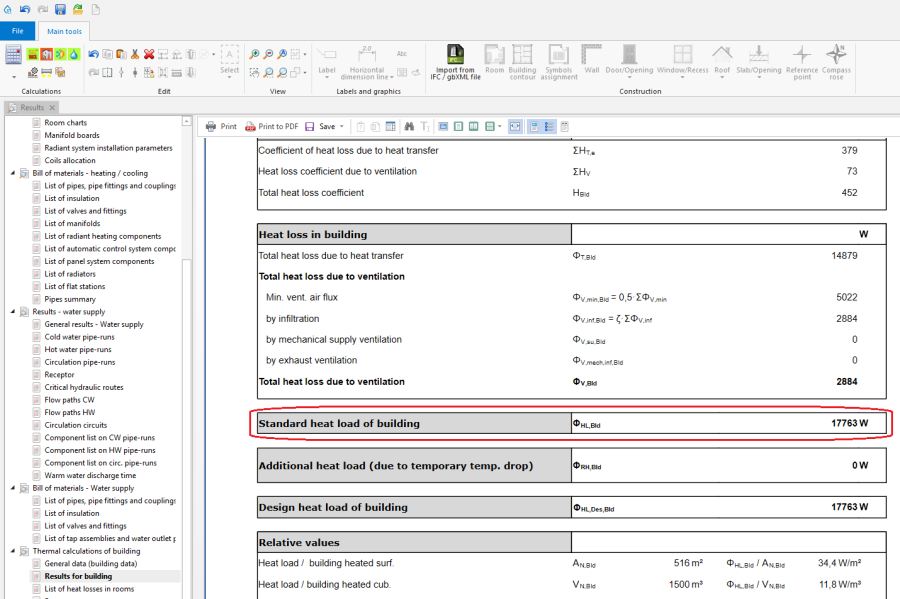
2. Projektowe obciążenie cieplne budynku. 
3. Suma obciążeń cieplnych pomieszczeń. 
4. Straty ciepła działek, straty ciepła ogrzewań płaszczyznowych.


